

























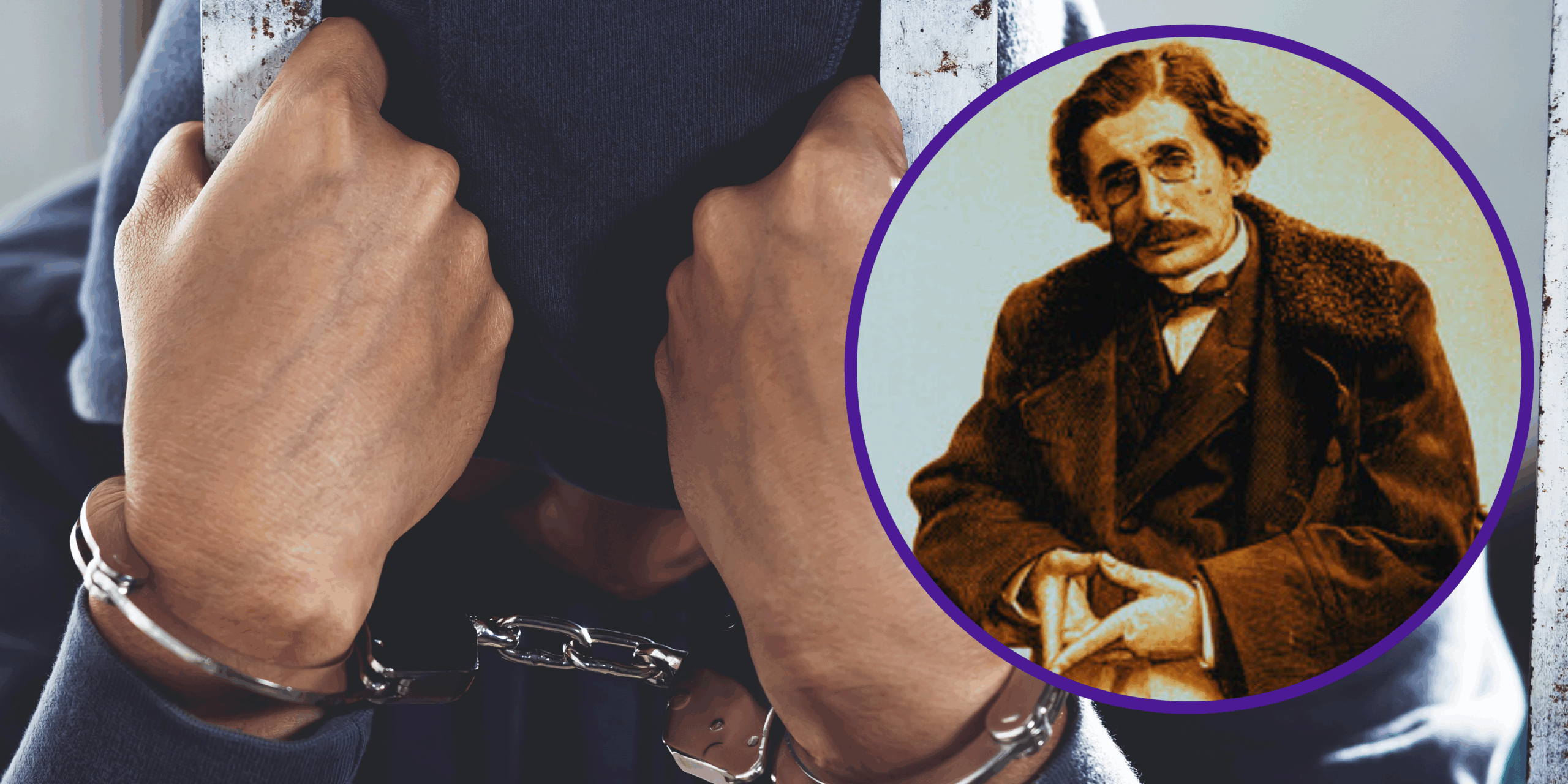
Tarde's sociological studies of crime can be contextualized in the contemporary hyper-communicative world. How? Through a path that goes from Tarde's (1911) concept of imitation to progressive emulation.
Studies of crime by psychological factors
In Tarde's 1911 studies on society and irrational psychic forces, it is possible to grasp the ultimate foundations of society by starting from psychology. In "The Laws of Imitation: A Sociological Study," Tarde addresses the sociological problem of crime by referring to psychological factors. Given the tendency of individuals to imitate and thus repeat what others do, the regularities of society can be explained according to a "scientific" foundation. Society, the union between individuals, can be adequately explained only on the basis of the concept of imitation. The individual in society believes he is acting autonomously, but, like the hypnotized person, he actually acts only by imitating others.
Moreover, as is well known, Max Weber's social action can be determined: rationally with respect to purpose, rationally with respect to value, affectively and traditionally.
Contextualizing Tarde's imitation
In the contemporary era, the application of Tarde's studies on the Laws of Imitation is emphasized by the overwhelming representations produced by the mass media. Television, the web, and even more so, social media, have become increasingly powerful means of communication, exerting the so-called influence of opinion leaders, as described by Kats. Consider the representation of current events through the most powerful media, which, in Tarde's terminology, "hypnotize" individuals and, in the contemporary world, influence the masses.
The redundancy of information, the aggressiveness of journalists in seeking "news," even at the cost of creating it, or exaggerating it, enriching it with sometimes invented details. The sensationalization of news, even beyond media hype, for the sole purpose of increasing ratings or views for greater profit. These are all factors that influence the weakest, most fragile, and least educated individuals.
Emulation issues
And so, in today's competitive world, many individuals, especially the most vulnerable, who live on the margins of society and have no concrete goals of social affirmation, are strongly influenced by the news, which they tend to emulate in a worse way. Emulation occurs by imitating the worst of the most deplorable actions and very often pushing oneself to do worse . Consequently, progressive emulation is created.
When a criminal gang is driven to commit increasingly heinous acts, according to the principle that criminal dominance requires increasingly heinous crimes. Media redundancy, practiced compulsively to seek news within the news, fosters the pursuit of popularity through criminal dominance perpetrated through increasingly brutal forms of violence.
Effects of progressive emulation
Progressive emulation is strongly driven by media excess, which operates according to market logic. Therefore, if a crime story is reported and publicized by aggressive journalists with media techniques that spectacularize everything, it is perceived distortedly by the community. The most vulnerable, the less educated, and those with poor social values are predisposed to perceive such messages in a distorted way, seeking to emulate the protagonists of the story, progressively pushing themselves to do worse.

The media aren't interested in the message they're conveying at a given moment, but only in the audience or viewer ratings, which, if high, can secure sponsors' advertising space. Therefore, if the sensationalization of a crime story generates high ratings, the media system compulsively pushes communication , deploying the best communications technicians and journalists to the point of communicative profiteering.
From Tarde to media fascination
Weak, poor, and undereducated communities are captivated by this narrative, and their members are increasingly driven to emulate the protagonists, even pushing themselves to do worse. It's a relentless pursuit of popularity at all costs, where sensationalism and presence are far more important than the message. One example is the hordes of young people who band together in veritable criminal gangs, driven to commit crimes of increasingly heinous method and violence.
Digital home entertainment platforms are brimming with television series that tell the stories of criminal gangs. The constant pursuit of ratings tends to emphasize the violent acts perpetrated by the protagonists, portraying them as leaders who are allowed everything in defiance of the rules of social coexistence. This creates protagonists who are emulated by viewers who already experience social hardship, becoming violent themselves. The role models represented by gang leaders, leaders of criminal communities who gain mastery and respect through violence and ruthlessness, are emulated by young people on the margins of society. Thus, the commitment to pursuing social affirmation through education and work is diminished, preferring instead to join the violence of criminal gangs who commit increasingly heinous crimes in order to assert their criminal supremacy and become "popular."
Eugenio Ghiglione
Bibliography
- E. Katz and P.F. Lazarsfeld. Personal Influence in Mass Communication. (1968) (RAI Publishing 2011)
- G. Tarde. The Laws of Imitation. Studies in Sociology. (1911) (edited by Rosembberg and Sellier 2017)
- Max Weber. Economy and Society. Community. (Donzelli 2005)


