


























Social anxiety and phobia are today's enemy in a world split in two. On the one hand, we isolate ourselves within the intimacy of our own micro/macrocosmos, made up of virtual encounters and intangible realities, opened and closed with a simple click. On the other, the increasingly open and globalized community requires us to acquire a flexible and mimetic nature like never before. The result is a constant dichotomy where light and shadow, openness and closure, individualism and collectivism collide, merge, and blur. This constant tension between opposites is difficult to manage. The result is that more and more people no longer know how to speak in public without becoming emotional and uncomfortable.
What are the causes?
Freud argued that knowing the causes eliminates the effects . This is still true. By analyzing the causes of destabilizing socio-cultural phenomena, we quickly discover what can be called the solutions. According to the authors of the cognitive model of social phobia, two factors underlie the panic that occurs when standing in front of an audience:
1. conditional beliefs
2. negative and catastrophic thoughts.
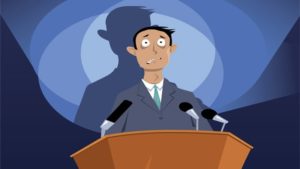
In other words, social anxiety about public speaking is based on dysfunctional thoughts and attitudes that are often debilitating for those who suffer from them. Conditional beliefs can be defined as rigid and anxiety-inducing certainties. The formula is " If...then ." Therefore, " If, caught in uncertainty, I make a mistake in expressing myself, then I will look incompetent ." Conditional beliefs insinuate themselves deeply and then generate so-called catastrophic negative automatic thoughts , true "monsters" capable of creating a negative self-image to the point of rigidifying and nullifying any momentum. The constant self-monitoring that these attitudes force us to endure leads those who suffer from them to focus their attention exclusively on the negative aspects, sometimes nonexistent. The consequence of all this will be marked by symptoms, namely sudden mental confusion , a strong sense of tremor , hot flashes and, in the worst cases, full-blown panic attacks . Many people today suffer from these disorders and wonder how to speak in public without getting emotional, without going through this hell. And fortunately, it's possible to escape this vicious spiral.
The right exercises to do
It's simpler than it seems; you just need to master a method and commit to it with self-discipline. Among the exercises that can help you finally understand how to speak in public without getting emotional, you can start with a list of the things that generate anxiety and fear when you're in front of people or an audience—the anxieties and fears that arise. That is, ask yourself how you feel before giving a public speech. Writing down on a piece of paper the emotional states that shatter the moment anxiety begins to rise will help you recognize them, name them, unmask them, and gradually exorcise them. At the same time, you need to focus on the present . It may seem trivial, but learning to practice divergent thinking —the opposite of dysfunctional thinking— will be incredibly helpful . Living in the present, immersing oneself in the here and now, is one of the most difficult activities to learn today, given the numerous external, anxiety-inducing, and demanding distractions. We don't have time to look at ourselves in the present because reality demands we always push ourselves further. Instead, we need to take a journey backwards, starting from today. And from ourselves. We need to shift our attention from having to being . Anxieties, phobias, and worries belong to the realm of having. The present and the importance of what we are are part of the dimension of being. Phobias and anxieties are acquired, but they can also be rid of. We must always bet on ourselves, because this is the right investment.

Public Speaking Course: The Quickest Solution to Microphone Fever
If you need to learn how to manage so-called microphone anxiety quickly and with the help of an expert in the field, you might consider taking a public speaking course . In a public speaking course, you'll quickly and easily learn how to manage social performance anxiety ; in other words, you'll understand once and for all how to speak in public without getting emotional. Coach Riccardo Agostini, for example, holds online and individual public speaking courses, aiming to meet any need, whenever you want. With a public speaking course, you'll acquire the most effective method for communicating with others confidently and constructively.
Rino Carfora
© ALL RIGHTS RESERVED


