


























Shoes are a very particular consumer good: while from a functional standpoint, their importance is immediately apparent, having accompanied human evolution and people's lifestyles (think of the transition from religious barefooting to the comfort and performance of memory foam and similar racing shoes), from an identity perspective, sociology reminds us, their impact on people is much more complex and multi-layered. A transdisciplinary reflection on the topic is offered by Tommaso Ariemma, a contemporary philosopher previously consulted for another of his contributions , in his text " The Feet of the World: How Nike Shoes Have Revolutionized the Global Imagination ," in which he provides an in-depth and innovative analysis of how a brand can transform into a cultural symbol of universal significance.
Sociology and Philosophy of Nike Shoes

The book explores how Nike shoes evolved from simple functional tools into powerful symbolic devices, capable of influencing collective imaginations and redefining individual identities in a globalized world. A discourse that intertwines the history of thought, design, and aesthetics: all philosophical dimensions that are grafted onto social practices.
The author, through philosophical and sociological lenses, interweaves direct and implicit references to thinkers such as Heidegger, Benjamin, Barthes, Bourdieu, Illouz, and others, leading us on a journey from the concept of technique to myth, from the aestheticization of consumption to globalization, revealing the cultural and ideological dynamics hidden behind a seemingly simple object: sneakers.
Let us now try to structure a brief overview of this writing.
The foot as a philosophical symbol
The book's title itself, The Feet of the World , is a symbolic reference to the role Nike shoes play in the contemporary world: they represent the contact between the body and the ground, between the individual and the world. Ariemma, in fact, critically draws on Heidegger and the concept of Ge-stell , interpreting Nikes as a technological extension of the human body, a prosthesis that not only allows movement, but defines our way of being in the world. They are not simply shoes: they become the logos of capitalist dynamism , the means through which contemporary man "tramples" the world to possess it, dominate it, and conquer it... or at least constitutes its most "materialistic" illusion.
The myth and archetype of the hero through Nike shoes
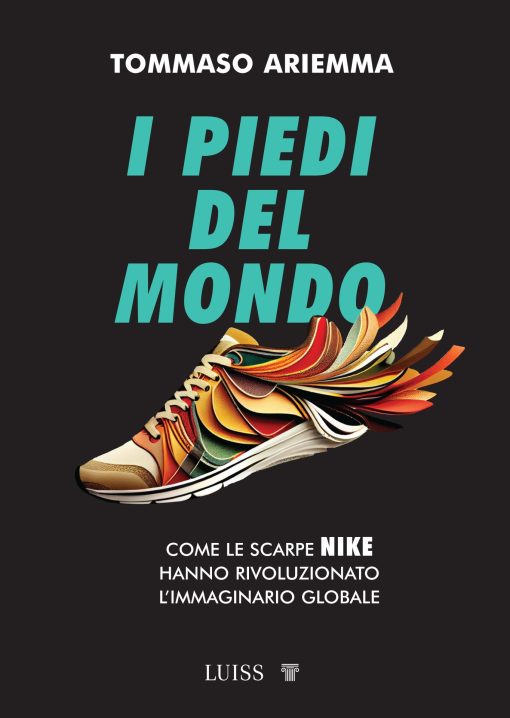
Ample space is devoted to analyzing the myth created around Nike shoes, from the evocative "V" symbol, which evokes Greek dynamism and the mastery of the air of the 80s (p. 36), to the use (for the first time in history) of a celebrity, Michael Jordan. Nike's advertising campaigns don't sell shoes, but universal narratives that echo the archetypes of myth, as Joseph Campbell describes in his monomyth of the hero's journey. Jordan becomes a modern Heracles, capable of rising above human limitations thanks to his own strength, sacrifice, and, last but not least, his shoes.
This mechanism recalls Roland Barthes and his concept of myth as a system of signs ( Mythologies ): Jordan's figure is mythologized through Nikes, which become the tangible symbol of success and overcoming one's limits. Buying Nikes is therefore not just an act of consumption, but an adherence to a myth, a symbolic participation in the narrative of personal triumph.
The aestheticization of consumption… of Nike shoes
Nike shoes are not simply functional objects, but aesthetic and symbolic products, transforming the body into a work of art to be exhibited. Framing the discussion within the perspective and reflections of Walter Benjamin in "Art in the Age of Mechanical Reproduction," it's possible to argue that Nike shoes exist midway between exclusive luxury and mass production, creating a tension between perceived uniqueness and global accessibility. It is precisely this paradox that fuels their symbolic power.
Sneakers are also part of contemporary "visual language," a form of spectacle, as Guy Debord describes in The Society of the Spectacle . Wearing a pair of Nikes means displaying a status, an identity, a history. The shoe thus becomes a communicative object, an integral part of the system of signs with which the individual presents himself to the world.
Hedonistic capitalism and the commodification of identity
Ariemma places the Nike phenomenon within the context of "hedonistic capitalism," a concept developed by Gilles Lipovetsky. Shoes are purchased not out of necessity, but for the pleasure of owning them and identifying with them. Nikes promise not only improved athletic performance, but also a stronger personal identity, a participation in a collective imagination that combines aesthetics, dynamism, and success.
However, the author clarifies that rather than a mimetic relationship where one buys a product to resemble its testimonial, we should speak of a meta-relationship: buying Nike shoes meant (meant) participating in something extremely relevant, embracing a real domain (p.31).
Cultural homogeneity and local resistance
Ariemma, therefore, explores how Nike shoes have become a symbol of cultural globalization, capable of uniting diverse imageries under a single aesthetic and value banner. This recalls Arjun Appadurai's concept of "global cultural flows" in Modernity at Large , in which objects and ideas move freely, transforming local cultures. However, as the author emphasizes, Nike's global success is not only due to their widespread use, but also to their ability to adapt to local contexts.
For example, Nike has successfully appropriated urban subcultures like hip hop and skateboarding , transforming resistance practices into mainstream styles. This process of "cultural appropriation," however, carries the risk of a loss of authenticity and cultural diversity, a central theme in the debate on globalization.
The “feet of the world” as a metaphor for contemporary existence?
The Feet of the World is not just a book about Nike shoes, but a critical analysis of contemporary capitalism, globalization, and the relationship between identity and consumption (Illouz, 2021). Nikes, in this reading, are not simply shoes, but symbols of a world in motion, a global visual language, and a device through which capitalism aestheticizes and commodifies everyday life. The author invites us to question what it truly means to "trample on the world" and what the price of doing so while wearing shoes is.
References
- Ariemma T., The Feet of the World: How Nike Shoes Revolutionized the Global Imagination, Rome, Luiss University Press, 2024;
- Illouz E., The End of Love: A Sociology of Negative Relations, Polity PR, Cambridge, 2021;

Lecturer in Communications and HR Management. Journalist with a degree in Sociology (cum laude). Editor-in-Chief of Sociologicamente.it.
PUBLICATIONS | LINKEDIN


