


























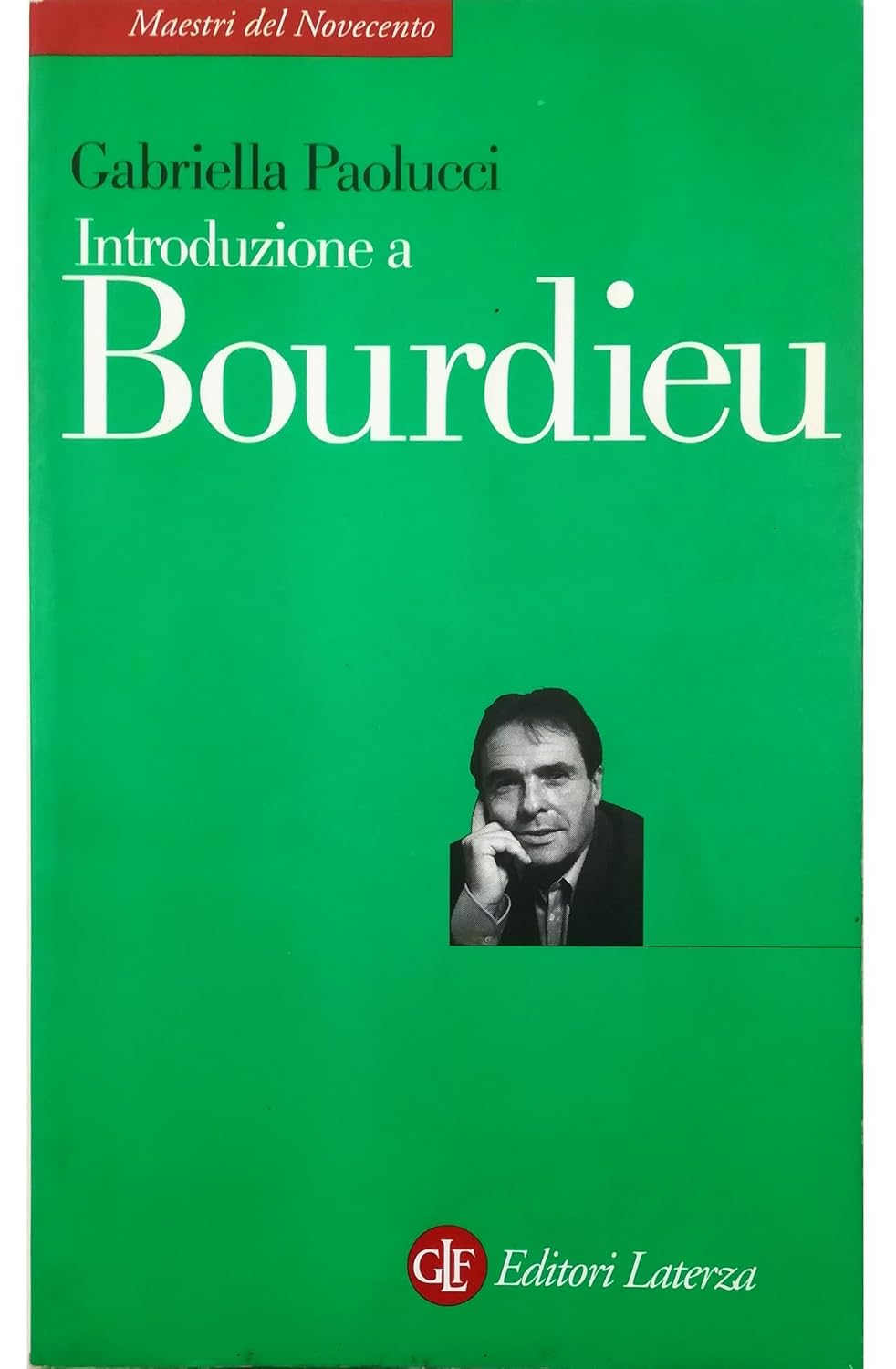
Pierre Bourdieu was born in Denguin, a small town in the French Pyrenees, on August 1, 1930. He was perhaps the most important European social scientist of the second half of the 20th century, and from the 1980s onwards he became one of the most frequently cited French sociologists in the United States. Influenced simultaneously by Marxism and structuralism , Bourdieu was particularly interested in the study of cultural processes , developing several fundamental ideas for understanding society within a structuralist vision according to which the social world contains structures independent of the individual's consciousness and will, which define the behavior of social actors. Bourdieu's most important text is Distinction: A Social Critique of Taste (La distinction. Critique sociale du jugement – 1979), named by the International Association of Sociological Studies as one of the ten most important sociological works of the 20th century.
The thought of Pierre Bourdieu

Pierre Bourdieu likes to define his theoretical position as " structuralist constructivist ": in his view, individuals can construct social phenomena through their thinking and actions, but such construction always occurs within an inescapable structure that can never be removed. The French sociologist attacks Talcott Parsons and his "functionalist structuralism," believing that social actors are not automatons who conform to the roles imposed by society, but rather enjoy a certain freedom of action, are creative and unpredictable, and employ a common sense that allows them to adapt to the most diverse situations. Thanks to common sense, Bourdieu notes, we can adjust our role from time to time based on the specific situations we encounter, adapting to them.
Bourdieu's position thus seems to be halfway between the determinism of the structuralists and the "voluntarism" of the interactionists. In particular, interactionists (e.g., Erving Goffman ) exaggerate the ability of individuals to negotiate identity and define the situation. By criticizing interactionism , Bourdieu discovers materialism in its Marxist sense.
Symbolic violence and habitus
In the early 70s, Pierre Bourdieu developed the concept of symbolic violence , which he believed was connected to educational processes. This concept refers to forms of violence exercised not through direct physical action, but through the imposition of a worldview , social roles, cognitive categories, and mental structures through which the world is perceived and thought about, by dominant subjects on dominated subjects. It therefore constitutes a "soft," invisible violence, exercised with the unconscious consent of those subjected to it and which conceals the power relations underlying the relationship in which it occurs.
Closely connected to symbolic violence is the concept of habitus , that is, the way in which a social being internalizes the dominant culture and reproduces it. For Bourdieu, habitus is the key to cultural reproduction, which—being closely linked to the class structure—is capable of generating regular behaviors that shape social life.
Bourdieu's Four Types of Capital
Following Karl Marx, Pierre Bourdieu believes that each of us moves within a certain ideology depending on our class affiliation. The French sociologist, going beyond Marx, distinguishes between four different types of capital: economic capital (money, means of production); social capital (social networks); cultural capital (languages, tastes, way of life); and symbolic capital (symbols of legitimacy).
Based on this distinction of capital, Bourdieu can distinguish different social classes: in this, too, he remains faithful to Marx but at the same time goes further. Indeed, Marx's distinction between the bourgeoisie (rulers) and the proletariat (ruled) is today completely inadequate for understanding a social situation that has become more complex and intricate. The uppermost class, Bourdieu says, is the one with the greatest presence of all four types of capital: but this does not mean that classes are hierarchical and fixed as in Marx. The three main classes (upper class, middle class, lower class) are in turn divided into three internal levels: thus, the upper group of the upper class may find itself sharing the interests of the upper group of the middle class. It finds itself in a situation where communities of interests exist that transcend class differences. Pierre Bourdieu died on January 24, 2002, in Paris, at the age of 71.
Rino Carfora


