

























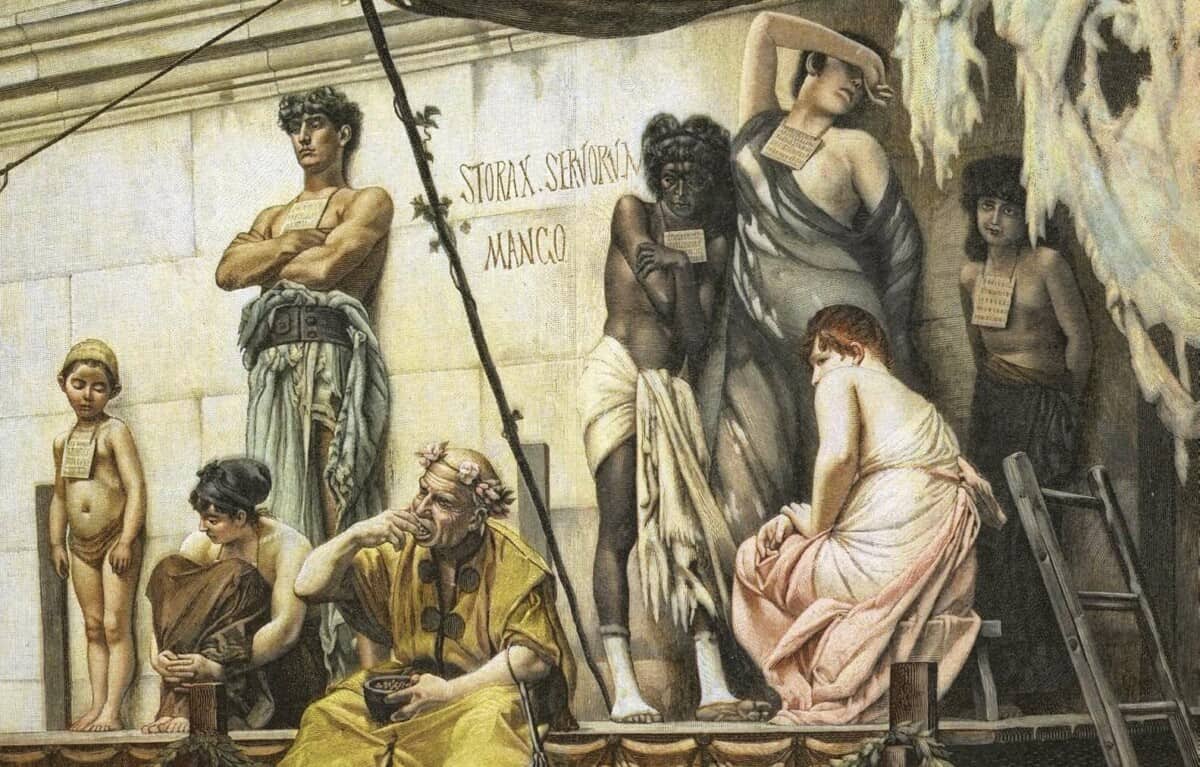
Imagine strolling through the Italian countryside two thousand years ago: fields of wheat, farmers tilling the soil, a sense of peace and simplicity. Then, suddenly, Rome decides to conquer half the world, and everything changes . It's as if an economic and social tornado hits Italy, bringing buckets of money, millions of slaves, and an elite enjoying the festivities while the peasants are left empty-handed.
Welcome to the second article in our series on Sociologicamente.it , based on Keith Hopkins's "Conquerors and Slaves ." Today, we dive into the chaos of the 2nd and 1st centuries BC, when the Roman conquest transformed Italy from a quiet village to the center of an empire. Take a seat, and I'll tell you a story of money, slaves, and large estates!
The boom of conquest: a wave of slaves and booty
Let's take a step back. Between 200 and 100 BC, Rome was a war machine: it conquered Greece, Spain, North Africa, and so on. Each victory brought home a staggering amount of loot—gold, silver, treasures seized from enemies—and an army of prisoners who ended up as slaves. We're talking staggering numbers: Hopkins estimates that during this period, something like two million slaves arrived in Italy. Two million! It's as if today the entire population of a city like Milan were sent to work in someone else's fields.
These slaves don't arrive empty-handed: with them comes the spoils of conquest. Think of the Roman triumphs, those spectacular parades where generals marched through Rome displaying chariots laden with riches. It's a spectacle, sure, but also a signal: war pays, and pays well. This flood of money ends up in the pockets of the rich—senators, nobles, those we would now call the "1%"—and changes the face of Italy. Rome, from a large village, becomes a glittering metropolis, with temples, monuments, and a population that explodes to a million. It's an economic boom, but not for everyone: while the elite toasts with the finest wine, someone else stands to lose everything.
From peasants to large estates: a change that sweeps away
And here we enter the heart of the story. Before the conquests, Italy was a mosaic of small farms: peasant families growing grain, perhaps a little oil and wine, living off what the land provided. It was a simple, subsistence economy, producing just what was necessary and little more. But with the arrival of money and slaves, this world was turned upside down. The rich, their pockets full of loot, saw an opportunity: they bought land—sometimes by fair means, sometimes by foul—and transformed it into latifundia, enormous estates run like modern farms.

What happens to the farmers? Well, they're being evicted. It's a bit like a large supermarket chain opening everywhere today, crushing the small neighborhood shops. Family farms can't compete: the large estates employ slaves, who work for free or almost nothing, and produce enormous quantities of food to sell in Rome and nearby cities. Wheat, wine, olive oil: everything needed to feed a starving capital and make money for the owners. Some lands are even converted to pasture for sheep or cows, because wool and meat are more profitable. It's a radical change: fewer free farmers, more slaves, and an economy shifting from subsistence to large-scale market-based production.
But it's not just a question of money. Slaves are the perfect workforce for the rich: they have no families, they don't strike, and you work them to the bone. Sure, buying them costs money, and you have to monitor them to prevent them from running away or rebelling, but it's worth the risk. Hopkins explains it well: with large estates, a smaller number of people produce much more, and the profits all end up in the hands of a few. It's a brutal but effective system, which transforms Italy into a kind of agricultural factory for the empire. Meanwhile, what about the free peasants? They either end up destitute or have to find another way to make a living—but we'll talk more about that later.
A parallel with today (and some mind-boggling numbers)
Does this sound like a distant past? Not really. Think about what happens when a large industry arrives in a rural area: small local producers close down, workers are replaced by machines or
cheap labor, and the money ends up in the upper echelons. Something similar happens in Rome, only instead of machines, there are slaves. And the numbers are shocking: if two million slaves seem like a lot, consider that at the end of the 1st century BC, they may have comprised 35-40% of the Italian population. It's as if today a third of Italians were forced immigrants from another country—a huge social shift.
And Rome? It becomes a city that thrives on this system. Grain arrives from provinces like Sicily, but also from the new Italian estates, farmed by slaves. Poor citizens, those who no longer have land, flock to the capital, attracted by free grain subsidies—a sort of citizen's income of the time—and the odd job. The elite, on the other hand, enjoys luxury: enormous houses, banquets, and a competition to see who can show off the most. It's a two-speed Italy: on one side, the large estates and triumphs, on the other, those who try to avoid sinking.
Towards politics: the chaos doesn't end here
Okay, we've seen the economic and social aspects, but the conquest doesn't stop there. All this upheaval—slaves, large estates, evicted peasants—creates a political mess that Rome struggles to manage. Land becomes an obsession, the poor become angry, and the rich don't give an inch. How do the Romans avoid collapsing under the weight of their own success? In the next article, we'll dive into the fray: we'll talk about politics, land conflicts, and drastic solutions like sending everyone into the army or living elsewhere. It's a story of tensions and strategies, and I assure you it has nothing to envy of a modern thriller.
So, what do you think? The conquest has turned Italy upside down, and this is just the beginning. See you at our next chat—bring your curiosity, the journey continues!
Biagio De Risi


