


























We're in the midst of summer 2024, some are planning their holidays, others are already enjoying them. And as always, the editorial staff is here to help with #readingtips , a short list of books to consider while you're sunbathing. A new addition to the substantial ones of 2020 and 2022 , with new, hot-off-the-press texts and interesting reprints. In short, here are some of the texts chosen as the best books for summer 2024.
What is Sociology? Franco Ferrarotti's new textbook for summer 2024
In some ways, it's a return to basics for the great scholar and professor Franco Ferrarotti, who tirelessly presents his latest work, " What is Sociology?" , published on June 28, 2024. The author begins with fundamental questions: what is the role of science in our society? Why can't we do without socioeconomic analysis to plan a new future? How can we understand the interaction between social facts in a system as complex as our current societies?
Sociology is not the science of society as a whole, analyzed exhaustively. Nor is it the translation, so to speak, of a political judgment. In this essay, Franco Ferrarotti proposes a sociology understood as a science capable of studying the reciprocal influences between different aspects of social issues , as the science of the costs and psychological repercussions of social reforms. Only in this way can it become a tool capable of demystifying reality and analyzing the gap between written norms and practical practices.
Luca Mecca and the Sociology of Consumption and Fashion
The next book recommended for summer 2024 is by Luca Mecca, titled "Sociology of Consumption and Fashion: Fashion as an Ecosystem that Shapes and Reflects Society ." According to the author, the fashion industry is a complex and dynamic ecosystem that shapes and reflects social values, identities, and cultural narratives. This book delves into the multifaceted world of fashion sociology, focusing on the intricate interplay between the fashion industry and social trends (social trends and aesthetic core).
Using a multidisciplinary approach incorporating sociological and anthropological theories, ethnographic research, and data-driven analysis, this study aims to shed light on the profound—and evolving—relationship between fashion and society. Through extensive ethnographic fieldwork, including interviews with industry insiders, designers, consumers, and trendsetters, this work uncovers the intricate processes of trend formation within the fashion ecosystem. It explores the role of influencers, social media, fashion weeks, and consumer culture in shaping the direction of trends, as well as the power dynamics underlying these processes.
By combining empirical data with sociological insights, this work aims to help explain the intricate relationship between the fashion industry and social trends , providing insights for scholars, policymakers, and industry stakeholders seeking to navigate the hyper-accelerated and ever-changing fashion landscape and its profound implications for contemporary culture and society. Ultimately, this research aims to foster a more informed and nuanced discussion on the role of fashion in shaping our collective identity and values in an increasingly fluid, interconnected, and fast-paced world.
Žižek's socio-philosophical plot returns for this summer of 2024.
An interesting revisit—and interesting read—is Slavoj Žižek's "What Is the Imaginary?" In this text, the author asks: how can we escape the storm of images, information, and technological relationships that inundate us? Where can we find a firm foundation to anchor our perception of the reality that surrounds us? Once upon a time, says Slavoj Žižek, things were simpler: ideologies could be criticized as "mystifications" precisely by appealing to a sense of reality. Today, however, we must proceed in reverse: since reality has become virtual, we must criticize it starting from its illusory supplement: from the side of the imaginary.
One of the main tasks of philosophy today would therefore be to subject to criticism the status of the imaginary and its relationship with reality; except that Zizek shows us that things are not like this : the distinction between reality and the imaginary is false, and is itself real and imaginary.
Zizek intertwines history's greatest thinkers with the most diverse exponents of popular culture, creating a discourse that examines the notion of the imaginary, how it animates pleasure and tempers its excesses, the structuring of fetishism, and ultimately the metamorphosis of subjectivity in the digital age. "What Is the Imaginary?", formerly known as "The Epidemic of the Imaginary," and now republished by Saggiatore in a revised edition, is a text in which our habitual thought patterns are subjected to extreme tension: a fundamental step towards learning how to detonate the framework of everyday and philosophical categories that sustain us.
Ferrara and Rosati at a crossroads of social theory
The next recommended text is by Alessandro Ferrara and Massimo Rosati, "Frescoes of Modernity. Crossroads of Social Theory ," published by Carocci. The authors ask: how and why do social orders, designed to reproduce themselves in the same way, change, generation after generation? What glue holds together complex societies traversed by a plurality of faiths, cultures, lifestyles, and interests?
Religion, change, integration, the individual, critique, and method are the crossroads that every theory of society is destined to traverse. This book—linked to the research of the Gallarate Group and the Urbino Seminar—explores each of these crossroads, reconstructs the thread of the conversation of social theory or philosophy, and restores to us those frescoes of modernity through which we still understand what it means for us to be modern.
For summer 2024: Davide Sisto and the digital revolution
The last recommended text is by Davide Sisto, "Remember Me: The Digital Revolution Between Memory and Oblivion," published by Bollati Boringhieri. Facebook often recommends sharing memories from 1, 2, or many years ago, or even videos like "Your Year on Facebook." It is precisely this look back—on which social networks are increasingly focusing—that gives Davide Sisto food for thought on how our relationship with memory and oblivion is changing in the digital age.
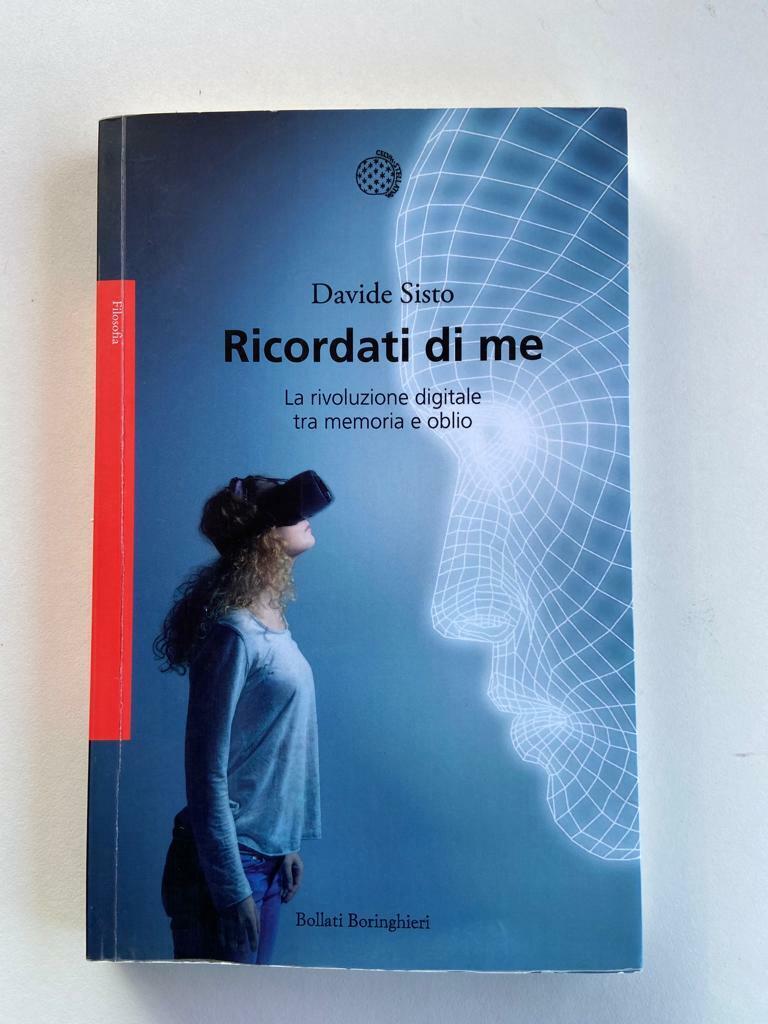
The past doesn't really exist: it's just a story we tell ourselves. But what happens when we tell this story not only to ourselves but also to our followers, recording it, along with millions of other users, on our social media profiles and online, making it accessible forever?
Social networks are becoming enormous digital archives , from which it is possible to construct—in a completely new way—a vast collective cultural autobiography, in which each person contributes words and images to outline both their own biographical profile and that of others, simultaneously shaping personal and collective memory. "Remember Me" helps us explore the ongoing digital revolution, which will leave future historians with a new kind of heritage.

Lecturer in Communications and HR Management. Journalist with a degree in Sociology (cum laude). Editor-in-Chief of Sociologicamente.it.
PUBLICATIONS | LINKEDIN


