





















As we grow older, we delude ourselves that the fairy tales we naively believed in as children no longer influence our worldview, allowing us to begin recognizing an objective, unfiltered reality. We fail to realize how certain narratives, words, and gestures still impact our collective imagination, our values, our ways of thinking and acting. Certain stories, broadcast in newspapers, on social media, and on TV, constantly invade our daily lives, shaping the majority's view. A much-discussed and widespread example is certainly the media coverage of femicide.
At the origins of femicide... and patriarchy
The term femicide was introduced by researcher and activist Diana E. H. Russell in the 90s to describe the killing of women by men for gender-based reasons, with a patriarchal basis. Patriarchy refers to a social system in which power, authority, and control belong to men. The precise origins of this form of division and oppression are still uncertain, but testimonies from ancient times speak of a social representation of women as subordinate to men, or even as a metaphor for the root of all evil.
A prime example is the Greek myth of Pandora : Zeus, king of the gods, gave a box to Pandora—the first mortal woman created by Hephaestus, god of fire—who, however, ordered her to leave it closed. However, Pandora disobeyed and opened the box, and from it came out all the evil spirits of jealousy, old age, disease, madness, and vice, rushing upon the world.
Aristotle
Or again, let us study, remember, and recount today the thoughts of Aristotle—one of the most renowned Western philosophers of antiquity—in which he expressed women's total inability to command, unlike men. Inferiority and atrocity intermingle and, over the centuries, shape the imagery tailored specifically to women.
The sinful nature attributed to female sexuality is also embodied in Greek society by numerous mythological female monsters: from the fearsome Sphinx, to the Erinyes, the Harpies, or the seductive Sirens, ready to deceive sailors with their song. Women are thus dehumanized and stripped of their individuality and autonomy.

The roots of patriarchal culture
Greek mythology may seem too distant from the 21st century , but certain arguments are still present today and have effectively become daily news: from economic inequality with lower wages for women, to a leadership gap with a clearly male majority, to a depiction of the female body as a purely sexual object, to laws that do not guarantee certain fundamental rights, such as the right to abortion, to the terror that walks the streets near every girl, with harassing glances, hands and voices, up to the bodies of abused, enslaved and even killed.
It's as if every woman had to follow a manual, which goes something like this: don't go on that last date, don't dress that way, don't laugh too loudly, nod SILENTLY. Don't argue, don't look, walk fast, don't stroll down that street, don't come home late, DON'T DON'T DON'T. Women grow up on bread and prohibitions, they learn early on NOT to trust men, their looks, their support. A constant hum accompanies their cradles. Clothing is always carved in marble by others, based on the context, the moment, and the desires of others.
Between prohibitions and fears
Prohibitions and fear, fear of going out, fear of walking, fear of working, of closing a door, of having TOO MUCH fun. That skirt was too short, that heel was too high, cover yourself up or uncover yourself but only when they decide, that laughter was too loud, too much alcohol drunk tonight, too much desire to dance, that shirt was too low-cut, and on and on and on . These words become lullabies as you drift off to sleep. Prohibitions, fear, and too many things to fix.
Born with this mortal sin—Eve the first guilty—carved into narratives, gestures, and glances. It remains encrusted under fingernails, in the comments thrown around on the street, in the eyes of passersby, in the hands of fathers, boyfriends, friends, priests, relatives.
When a woman thinks, hopes, that all this violence is to be condemned and has a clear idea of who is to blame, clearly remembers who scratched her, who threw the first object at her, who insulted her, who beat her, who raped her, often to the point of killing her, suddenly everyone else forgets it, as if it were a squalid spell and the victim turns into the executioner.
Patriarchal culture in the media and legislation
In newspapers, on TV, in barroom conversations, anger, terror, and nausea mingle. No one sees, no one hears , no one feels, and so the script taught since childhood continues to repeat itself. Just like that poem recited in school, where the teachers didn't expect just any phrase, but only those "fucking rhymes."
Patriarchal culture is also reflected in legislation, an example of which is our beautiful country, where honor killings were in force until 1981. Article 587 of the Italian Penal Code, dating back to the Fascist era, states: "Whoever causes the death of a spouse, daughter, or sister, upon discovering an illegitimate sexual relationship, and in a state of rage resulting from the offense to his or her honor or that of the family, shall be punished with three to seven years' imprisonment. The same penalty applies to anyone who, in the aforementioned circumstances, causes the death of a person engaged in illegitimate sexual relations with a spouse, daughter, or sister." In short, honor-motivated homicide could be granted a sentence reduction, a measure widely used to legitimize femicide.
The difficulty of narrating violence and femicide
That same year, the shotgun marriage law was abolished , a law that extinguished the crime of rape and violence when the perpetrator became the husband of the abused woman. When discrimination and violence become law, social and political change becomes difficult and slow, even when laws are abolished, such as honor killings and shotgun marriages.
This process is defined by the term institutionalization , through which norms and practices are structured into social life. Institutions imply the definition of roles, rights, and duties to be respected by members of a given society, also bringing about a shift in the cognitive patterns of individuals who begin to take the institutional presence in their lives for granted. Through symbolic, material, and cultural resources, the normative force of institutions strengthens over time. Indeed, over the years, media narratives, as well as some legal rulings, have not changed their approach when addressing issues such as femicide. According to an analysis of data from the Ministry of the Interior, 55 women were killed between January 1, 2023, and June 18, 2023, mostly in family/emotional contexts.

From January 1st to November 22nd, 2024, 100 women were killed, excluding dubious cases. However, politicians and most of the media are very reluctant to address and describe femicide and gender-based violence.
Frame of reference for femicide
In many articles, the term "femicide" is replaced by "murder ," completely obscuring the cultural responsibility for such killings. Furthermore, the psychological condition of the killer or relational dynamics are explored, downplaying a social phenomenon to a specific one. Other times, advice is offered to women on how to avoid being killed, without even mentioning possible educational and social interventions. Thus, on the front pages of the most well-known newspapers, we find magistrates urging women not to show up for their final appointment, blaming them for their own deaths.


Advertisements can even be found in the Milan subway advising women to be given the tools to combat violence. Whenever news is broadcast or communicated, it relies on frames of reference, coupled with values, beliefs, or stereotypes, stored over time and emerging like puzzle pieces to compose the media frameworks within which an event is described.
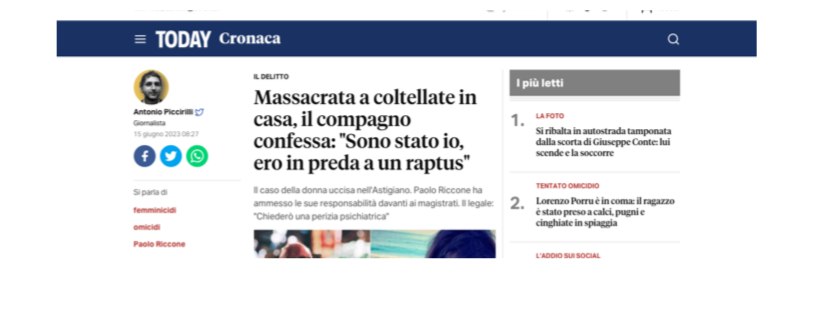
In the case of femicides, the same process occurs: a crime is described in a frame appropriate to public opinion. Choosing to use certain words rather than others helps convey the message, highlighting certain details rather than others. Drawing on researcher Pina Lalli's analysis in her book, "Love Doesn't Kill: Femicide and Public Discourse," we can notice a first detail when reading news reports about the killing of women:


These are just three examples that demonstrate how killing is not immediately classified as femicide, but the use of homicide, a more generic term that goes beyond the systemic problem of gender discrimination, continues to be preferred.
Other frames of femicide: rage and monster
Continuing our research, we can identify other frameworks. A very common word in journalistic vocabulary is the word "raptus." It is the individual man who had this sudden and uncontrolled impulse that drove him to murder. Thus, once again, the problem falls on the individual, catapulted outside of generic socialization and cultural responsibilities. Even when the term "raptus" isn't used, there's no shortage of purely psychological explanations that describe the killer as a victim of himself.

Always ready to dehumanize, they also use words rooted in an imaginary, fairy-tale world, the very one that terrified them as children. The monster is coming.

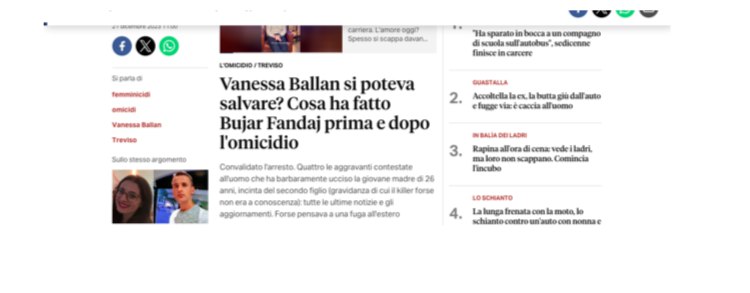
Connecting instead to the rhetoric of the advertisements posted in the Milan subway and Maria Monteleone's statements, when discussing femicide, one of the most common focuses is on the woman's behavior prior to the incident, questioning why she was not saved. According to this narrative, preventing violent behavior by men must be done by women . They should learn to defend themselves, to intercept the first symptoms of a sudden outburst, to recognize the behavior of a monster without questioning male behavior. Without attempting to intervene in the deconstruction of the role of men in social spheres and practices of domination.

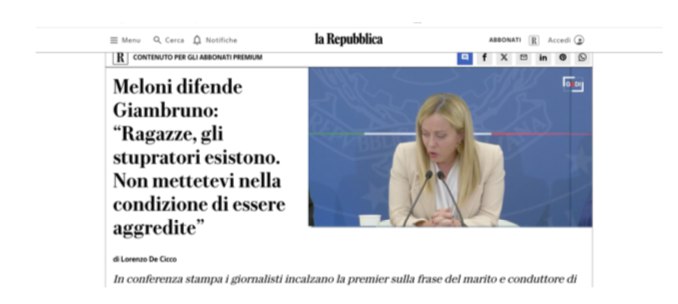

The question of "could she have been saved?" after a femicide also arises due to the countless reports from women and the lack of prohibitions on approaching or intervention by institutions. From January 1 to September 30, 2024, 1522 – NumeroAntiViolenza e Stalking – had approximately 48,000 contacts, including phone calls, apps, and chats. This represents a 57% increase compared to the first nine months of 2023.
The Giulia Cecchettin Case
When a woman decides to file a report, not all lawyers, law enforcement officials, or judges believe the words of a woman who has suffered violence. Often, in courtrooms, it is the woman who is questioned about her behavior and habits. This is called secondary victimization, when women are victimized a second time by institutions.
A radical change, therefore, must begin in every organization, including the courts. There has been much discussion about the femicide of Giulia Cecchettin , killed on November 11, 2023, by her ex-boyfriend. The victim's family immediately spoke out, including her father, Gino Cecchettin. After five hearings before the Venice Court of Assizes, her ex-boyfriend, Filippo Turetta, was sentenced to life imprisonment. Here's Gino Cecchettin's statement after the verdict:
We've all lost as a society. No one will give Giulia back to me. I'm neither more relieved nor sadder than I was yesterday. It's clear that justice has been done, but we should do more as human beings. Gender-based violence must be fought with prevention, not punishment. As a human being, I feel defeated. As a father, nothing has changed since yesterday or a year ago.
Social failure?
Social failure for every woman who continues to be discriminated against, harassed, raped, and murdered. Femicide could now be defined as a social fact : "any behavior, established or not, capable of exerting external constraint on the individual; or even (a behavior) that is general throughout a given society while possessing an existence of its own, independent of its individual manifestations." Naming an action, in this case, femicide, is one of the first steps toward a new model for recognizing social phenomena, defining different paths for a more inclusive and respectful collective life. Investigating the origins that led to this patriarchal system and seeking social responses to a structural problem.
There are no monsters, no outbursts, no unconditional love, only deep-rooted behaviors that must be analyzed and challenged to create a society where women can finally be free to be themselves. We must address gender violence not only with singular tools, but also through multiple channels, such as school, family education, and peer education. We must break out of this wall of silence, stop ignoring the various complaints, the screams from next door, the stories of friends, sisters, and mothers, or stop turning a blind eye to certain gestures and words from our friends, brothers, and fathers, and pretend that everything is fine.
The poetry of Cristina Torre Cáceres
Art is also a means of spreading symbols and messages capable of creating new horizons, such as the poetry of Cristina Torre Cáceres which has become a shared cry for many women:
"If I don't answer your calls tomorrow, Mom.
If I don't tell you I'm not coming back for dinner. If tomorrow, the taxi doesn't show up. Maybe I'm wrapped in hotel sheets, on a street, or in a black bag (Mara, Micaela, Majo, Mariana).
Maybe I'm in a suitcase or I'm lost on the beach (Emily, Shirley). Don't be afraid, Mom, if you see that I've been stabbed (Luz Marina). Don't scream when you see that they dragged me by my hair (Arlette). Dear Mom, don't cry if you find out that they impaled me (Lucía).
They'll tell you it was me, that I didn't scream enough, that it was the way I was dressed, the alcohol in my blood.
They'll tell you it was right, that I was alone.
That my psychopath ex had reasons, that I was unfaithful, that I was a whore.
They will tell you that I lived, mother, that I dared to fly very high in a world without air.
I swear to you, mother, I died fighting.
I swear, my dear Mom, I screamed as loud as I flew. You'll remember me, Mom, you'll know I ruined it when you face all the women screaming my name. Because I know, Mom, you won't stop.
But, for goodness' sake, don't tie up my sister.
Don't lock up my cousins, don't limit your nieces. It's not your fault, Mom, it wasn't even mine.
It's them, it will always be them.
Fight for your wings, those wings that cut me off.
Fight for them, so they can be free to fly higher than me. Fight so they can scream louder than me.
So that they may live without fear, Mom, just as I did. Mom, don't mourn my ashes.
If it's me tomorrow, if I don't come back tomorrow, Mom, destroy everything. If it's my turn tomorrow, I want to be the last."
Arianna De Maggio
References
- Silvia Campese, 1983, "Mother Matter: Woman, Home, and City in Aristotle's Anthropology," in Mother Matter: Sociology and Biology of the Greek Woman
- Erving Goffman, 1974, Frame Analysis: The Organization of Experience; Émile Durkheim, 1895, The Rules of the Sociological Method
- Pina Lalli, 2020, Love Does Not Kill. Femicide and Public Discourse
- Lorenza Pleuteri, November 25, 2023, Rights Observatory, Femicide: One Hundred Victims in Less Than Eleven Months in Italy, Available at: https:// www.osservatoriodiritti.it/2024/11/25/femminicidi/
- Annalisa Cangemi, 2024, fanpage.it, In 2024, calls from women to the anti-violence number 1522 increased by almost 60%. Available at: https:// www.fanpage.it/politica/nel-2024-aumentate-quasi-del-60-le-chiamate- women-on-the-anti-violence-number-1522/
- JenniferGuerra, 2024, fanpage.it, Gino Cecchettin's lecture on justice and gender violence


