




















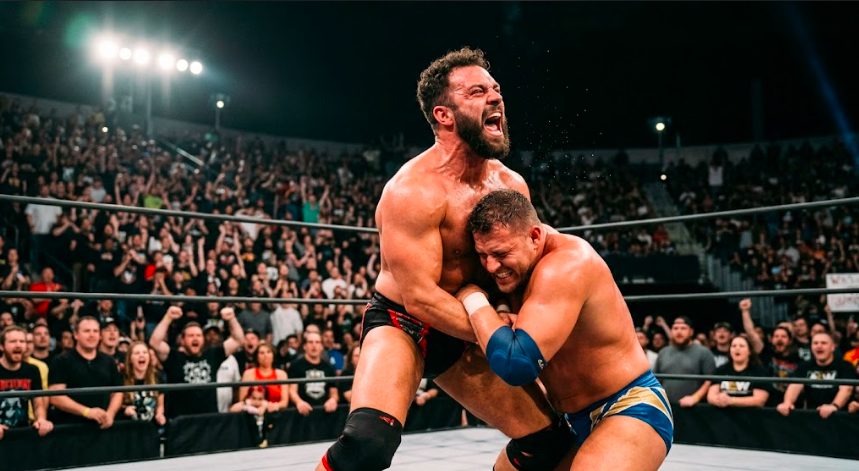
In recent years, the production of major professional wrestling promotions has undergone radical changes in its representation of masculinity. From presenting LGBTQIA+ characters in a more positive light and featuring wrestlers who in real life belong to the LGBTQIA+ category (Doc-Chris Mueller, 2022), to having a wrestler perform a spoken segment, inviting the male audience to cry to vent, to opening up about one's own fragilities and seeking therapeutic help when in difficulty (Woodward, 2025).
These elements are a clear indicative sign of the change that has occurred in the transposition of stories by the federations that propose the sport spectacle, given that Professional Wrestling, for most of its implementation, has been an entertainment based mainly on the popular transposition of the myth of aggressive masculinity (Ford, 2017).
Masculinity, aggression and the male body as a means of realizing identity
Professional Wrestling, since its transition from a legitimate wrestling competition to an entertainment sport, with an exclusive language to avoid leaking information to outsiders, a maintenance of the character, a practice that continued until the nineties and two thousand, even in real life (kayfabe) and a typology of product, especially in the American version and in particular in the southern areas, linked to a populist context (Stacey, 2023), has had as its main narrative the demonstration of masculinity and the affirmation of masculinity through aggression and the body (Soulliere, 2006). In fact, as indicated in her seminal essay, “Professional Wrestling: Sport and Spectacle”, Sharon Mazer indicates how even the use of female wrestlers and the sexuality of their characters served to explicit and indicate the masculinity and the masculinity of male wrestlers (2020).
Roland Barthes , one of the greatest exponents of semiotics, in his seminal essay on professional wrestling, “The World of Wrestling” (1957), identifies it as one of the most intelligible spectacles, based on the emptying of interiority for a complete expression of emotions and intentions through amplified Suffering, the main element that attracts the audience. The three main elements of wrestling for Barthes, Suffering, Defeat and Justice, are implemented through the violence and aggressiveness of a body that is usually aesthetically and structurally muscular and well-groomed (Smith, 2014).
The Masculine Melodrama
Henry Jenkins III, in his essay “Never Trust a Snake WWF Wrestling as Masculine Melodrama” (2006), identifies professional wrestling as a narrative setting where a patriarchal paradox is enacted: stories are enacted through the structure of serial fiction, usually aimed at a female audience, with the release of homosocial tensions and emotions through narrative methods and means that justify the emotional release, without violating the social protocol of emotional containment, thus allowing the myth of the stoic masculine to continue. Thus, masculine melodrama is based on the structures of melodrama identified by Peter Brooks (1995), namely the ontological ethical nature of the character, the self-appointment of the role, and a magniloquent and excessive soliloquy, thus allowing the complete explicitation and exaggeration of the emotional content.
In this way, male audiences can allow themselves to release their emotions, frustrations, and vulnerabilities without violating the social protocol of the male gender through the implementation of professional wrestling narratives, with themes ranging from friendship, romantic relationships, and politics, often through characters who are masks of populist narratives.
The view of masculinity in wrestling today
The narrative of masculinity in wrestling has undergone, as mentioned in the first paragraph of the article, changes, both linked to elements outside the narrative, such as the “#Speaking Out” campaigns (BBC, 2020), linked to the concept of #Metoo and aimed at denouncing the abuse and toxic male culture underlying professional wrestling, and to the character narrative method, such as showing athletes in out-of-ring contexts and above all with characters more in line with their real personalities, allowing their vulnerabilities to be shown more clearly (St. James, 2022).
Along with greater parity between female and male wrestlers, these changes in the masculine vision have been highly appreciated by WWE fans in the Trump era (McCreedy, 2021), whose method of political dialogue is compared, also given his collaborations with WWE, to that of the wrestlers' promotional cartoons (Cassini, 2020).
John Charles Bruni
Bibliography
- Mueller, Doc-Chris, AEW Stars Discuss Pride Month, Being Role Models, Discrimination and More, Bleacher Report, 2022.;
- Woodward, H. L.A. Knight: It's OK To Cry, It's Good For Your Mental Health, It Doesn't Make You Less Of A Man, Wrestle Zone, Yahoo Entertainment, 2025;
- Ford, S. (2017). “He's a real man's man”: Pro Wrestling and Negotiations of Contemporary Masculinity. In The Routledge companion to media fandom (pp. 174-183). Routledge.; – Stacey, C. L. (2023). Populism and Professional Wrestling in the Sunbelt South: From Rasslin' to Sports EntertainmentBloomsbury Publishing USA.;
- Soulliere, D. M. (2006). Wrestling with masculinity: Messages about manhood in the WWE. Sex Roles, 55(1), 1-11;
- Mazer, S. Professional Wrestling, Sport and Spectacle, Second Edition, University Press of Mississippi, 2020; – Barthes, R. (1957). The world of wrestling. Frolic Game Play Sport Toy & Wanton, 183.
- Smith, R. T. (2014). Fighting for recognition: Identity, masculinity, and the act of violence in professional wrestling. Duke University Press.;
- Jenkins, H. (2006). 4 Never Trust a Snake: WWF Wrestling as Masculine Melodrama. In The Wow Climax (pp. 75-101). New York University Press.;
- Brooks, P. (1995). The melodramatic imagination: Balzac, Henry James, melodrama, and the mode of excess. Yale University Press.;


