



















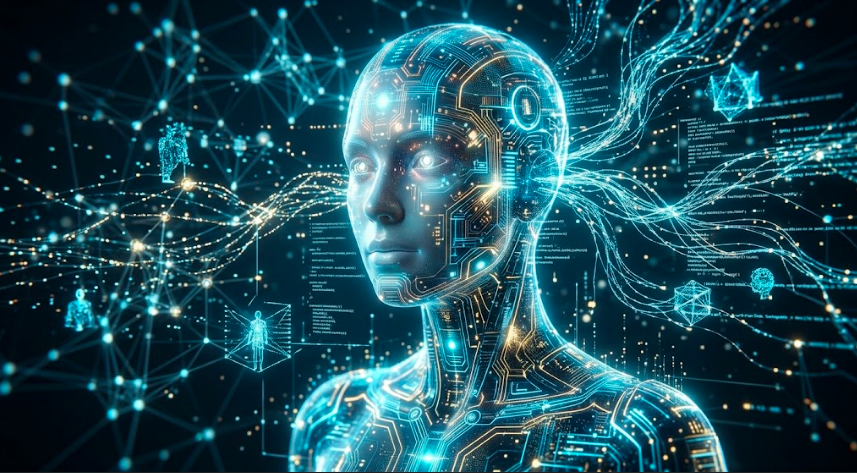
We ask ChatGPT for something: an explanation, a translation, a draft, an image. You write a few words, wait a few seconds, and the response arrives. Everything seems effortless, immediate, almost immaterial.
This is the great illusion of artificial intelligence: it appears weightless. We call it the "cloud," as if our data, our questions, and our conversations were floating somewhere above us, in a clean, abstract space. But the cloud isn't a cloud. It's made up of buildings, servers, undersea cables spanning oceans, chips manufactured within complex geopolitical supply chains, minerals mined in distant places, and a great deal of human labor.
The material and socio-technical infrastructure
It lives in data centers that guzzle electricity and require water for cooling, and in the hands of those who assemble devices, moderate content, label images, and clean datasets. When a response appears on the screen, it seems to come from an autonomous mind. In reality, it comes from a planetary infrastructure made up of things and people.
This is the first thing to understand. Artificial intelligence isn't just software. It's a sociotechnical system: you can't separate code from workers, models from data, servers from energy, automation from power.
Bruno Latour and actor-network theory help us see this clearly. Technologies are not neutral tools. They enter relationships, modify them, distribute possibilities and constraints. AI, too, exists within a network of humans and non-humans: users, companies, cables, standards, datasets, interfaces. An algorithm doesn't fall from the sky. It is built, trained, funded, sold, and integrated. Every step leaves social traces.
Kate Crawford and Vladan Joler, in their book "Anatomy of an Artificial Intelligence System ," have shown how even a seemingly simple object like the Amazon Echo with Alexa conceals a vast global supply chain: minerals, industrial labor, logistics, data, energy. Behind a synthetic voice lies an entire material world.
The myth of the "cloud" and the ecological footprint
I still remember a media training course a couple of years ago. A student, his eyes shining, said to me, "It's all about the cloud, it's magical!" That word—cloud—clearly bothered me for the first time. It wasn't its fault; it reflected how we've been taught to think of technology: as something ethereal, suspended, innocent. From that moment on, I began to see the same smokescreen everywhere. This materiality is often obscured by the language of innovation. We talk about "model," "cloud," "automation," "intelligence," "assistant." Smooth words that make everything seem neutral and inevitable. This is precisely what sociology is for: to remove technology from the fog of metaphors and bring it back into the concrete world.
When we say that AI lives on Earth, we're remembering that it depends on finite resources: computing power, specialized chips, massive amounts of data, electricity, water, global networks. Even the most elegant chatbot has a significant industrial footprint.
This imprint is visible even in small gestures. Adding "please" or "thank you" to a prompt seems trivial. But multiplied by millions of interactions, that surplus of words consumes processing, energy, and cooling. Politeness, on a global scale, comes at a material cost. The problem is that none of these images prompt the right questions: how much energy does a cloud consume? Who works to make a mind seem autonomous? Who controls what seems inevitable?
Invisible labor and machine fetishism
The first critical step is to look beneath the interface. Beneath the dialog box are models trained on massive amounts of text, images, and behavior, companies that decide rules, pricing, and access, cloud providers, researchers, content moderators, workers who labeled data and corrected output—and there are mines: cobalt in the Congo, lithium in the Bolivian salars.
Automation is often the result of a lot of invisible work. This is one of the strongest paradoxes of AI today: the more automatic a technology seems, the more it erases the people who make it possible. Work doesn't disappear. It changes location. It moves to platforms, to subcontracting, to low-wage countries, to repetitive microtasks, to psychologically burdensome restraint: AI appears intelligent because so many people have worked to make it appear so.
This isn't just a moral complaint, but a precise way of looking at the facts: artificial intelligence reorganizes the relationship between the visible and the invisible, revealing the answer and hiding everything behind it. It's an updated form of what Marx called commodity fetishism: we see the finished object and forget the social relations that produced it.
Data mining and power asymmetries
But AI isn't just about extracting labor and minerals. It's also about data mining. Every day, we transform ever-larger parts of our lives into digital traces: texts, images, searches, preferences, clicks, likes. This data becomes the raw material for predictive models, advertising, recommendations, and surveillance systems. Everyday life becomes training.
Data isn't a natural thing. It's produced by systems that decide what to measure, how to measure it, and how to transform it into value. Those who possess large amounts of data gain power: they anticipate behaviors, classify people, guide choices, and build dependencies.
This is why AI is also a question of power. Not everyone is equally invested in it. Some produce data almost without realizing it. Others collect it, organize it, and profit from it. Some regions provide minerals, jobs, and energy. Others concentrate profits, patents, and decision-making power.
AI is global, but it's not the same for everyone. Some use it as a service, some submit to it as control, some fuel it with invisible labor, and some cash in on its value. This asymmetry is fundamental. A system trained on historical data can inherit biases. A platform can intensify control over labor. A welfare algorithm can make it harder to challenge a mistake. Not because the code is inherently evil, but because it operates within already unequal social relationships.
Beyond technique: a political choice
This is where the entire column begins. Artificial intelligence isn't external to society. It's a form of society: it brings with it conflicts, ambitions, hierarchies, and possibilities. Therefore, it's not enough to ask whether AI is intelligent. We must ask: intelligent for whom? Governed by whom? Useful to what idea of society?
Technical wonder is real. A system that generates text, images, code, and translations produces genuine amazement. It can help us study, write, research, and assist others. But amazement must not lead to blindness. Every powerful technology brings both promise and reorganization. Sociology focuses primarily on the latter: not only what AI promises, but what it concretely transforms in our lives—in work, study, communication, welfare, school, policing, and geopolitics.
The question "What is AI?" is too trivial if it remains technical. The more useful one is: What kind of society does AI produce and is produced by?
The answer isn't already written. It can become a tool for knowledge, care, creativity, and accessibility. But it can also become an infrastructure for control, extraction, and surveillance. The difference isn't just in technology. It's in rules, economic models, institutions, and the collective ability to see what's hidden behind the interface.
This is why we must start from the earth. As long as we think of it as a cloud, we imagine it light and inevitable. Brought back to earth, however, we can truly discuss it: who works, who pays, who decides, who profits, who risks, who can oppose it. A technology brought back to earth ceases to be destiny. It becomes a matter of political choice.
This column was born from this. Not to explain AI like a manual would, but to look at it as a social fact. In future articles, we'll delve inside the machine and see the ghosts that inhabit it: the invisible workers, the moderators, the annotators, all those people who make automation possible while remaining outside the scene. Because the first secret of artificial intelligence is precisely this: behind many machines that seem to think, there are still humans at work.
Bibliography
- Casilli, AA (2019). En attendant les robots: Inquête sur le travail du click. Editions du Seuil. (It. trans.: Slaves to the Click: Why Robots Still Need Us. Feltrinelli, 2020).
- Crawford, K. (2021). Atlas of AI: Power, politics, and the planetary costs of artificial intelligence.Yale University Press.
- Crawford, K., & Joler, V. (2018). Anatomy of an AI system: The Amazon Echo as an anatomical map of human labor, data and planetary resources. AI Now Institute & SHARE Lab. https://anatomyofai.com
- Latour, B. (2005). Reassembling the social: An introduction to actor-network-theory.Oxford University Press.
- Marx, K. (1964). Capital: A Critique of Political Economy (Vol. 1). Editori Riuniti. (Original work published in 1867).
- Pasquale, F. (2015). The black box society: The secret algorithms that control money and informationHarvard University Press.
- van Dijck, J. (2013). The culture of connectivity: A critical history of social media.Oxford University Press.
- University of Turin. (nd). Artificial Intelligence Report. IRIS Open.


