


























The social research I conducted focuses on the family and the relationship between parents and children . In the previous article , I analyzed the family from a sociological perspective, comparing various types of families that have developed over time. In addition to the theoretical part, I developed a questionnaire that allowed me to collect very important data. Studying specific concepts based on the perception of the population sample helps to better analyze the topic. The data collected can provide insights for finding solutions to encountered problems. The questionnaire was structured with both closed-ended and open-ended questions. It was shared online for about two months , and I used Facebook as a means of dissemination. This allowed me to obtain a fairly large and random sample of the population. Let's look at the results.
Personal data
 The questionnaire is divided into sections. The first part concerns the personal data of the sample that participated in the survey. At the end of the administration period, the sample reached a quota 436 individuals: 86,7% are female, 13,3% are male. 39% of these are in the 29 to 40 age group, followed by 35,5% between 18 and 28, 13,9% between 41 and 50, 7,8% between 51 and 60, and only 3,8% are over 60. As for the degree, 39,9% of the sample has a high school diploma, 22,5% has a bachelor's degree, these are the most significant percentages. 39,9% is married while 16,2% is cohabiting. This is a significant percentage if we consider the birth of the so-called unmarried couplesThe number of families formed even without the bond of marriage is increasing. 40,2% are single and 3,5% of the sample is separated or divorced. As regards the work sphere, 26,3% are private sector employees, while 14,7% are public sector employees. 25,7% are students, 14,7% are unemployed, 5,2% are not in a job, 11,3% are self-employed, and 2% are retired. After defining our sample, let's analyze the percentages related to the research focus.
Family situation
 In this section, I've collected all the data relating to the sample's family situation. Today's families are no longer as large as they once were. Today, the average number of children per woman is 1,32, and mothers' chronological age also tends to be older: we're talking about an average of 39 years. Regarding the sample, 43,6% declared having a family unit composed of four members, 30,3% of three, 14,7% of more than five, and finally 11,3% of only two members. These data show that, however, the percentages do not speak in terms of large families. What could be the causes of the so-called "zero birth rate" in Italy? Today women are much more involved in the workplace, we are not yet on par with men but since the feminist movements of the 70s many things have changed. Despite the conquest of rights, many women still find themselves having to choose between career and children and this may be a response to the fact that today fewer children are being born and therefore, consequently, families are smaller. The economic factorMore children mean more money, and so this is also factored into single-income families. 50,3% of the sample has both parents employed. 42,8% are single-income families. However, there are also families in which children contribute to household expenses, 6,9%. The fact that children contribute to household expenses can be interpreted from two perspectives: if on the one hand, it is considered right for children to help their parents at home financially, especially considering that today children leave the family unit much later than in the past, on the other hand, this shows how much families, from an economic standpoint, are struggling to the point of relying on their children for help.It's not nice to get financial help from your child, it's the parent who has to succumb to the child's needs and not vice versa".
Family types
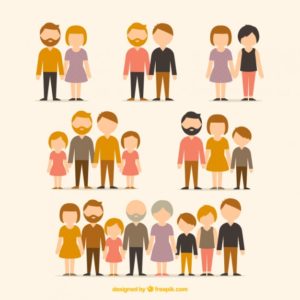 A family is a social unit consisting of two or more individuals living in the same household and typically related by kinship or affinity. The sample falls into the following family types: 77,7%, a significant percentage, are part of a nuclear family; 2% is part of a mixed family; 11,6% are part of a single-parent family while 3,2% is part of a rebuilt family; finally 5,5% are unmarried couplesThe data collected shows that more than half of the sample (77,7%) is part of a nuclear family. This type of family can be considered a traditional family composed of mother, father, and children and can be compared to other types, namely 2% mixed families, 11,6% single-parent families, 3,2% reconstructed families, and finally 5,5% de facto families. The data that can be discussed are precisely those concerning the comparison between the traditional family and de facto couples. Many variables come into play that, while on the one hand seem to point in the same direction, on the other hand are clearly contrasting. traditional family is linked by the bond of marriage then comes into play religious sphereThe rights that de facto couples enjoy, despite their lack of "bonds," according to some, have often been questioned. But what is a family based on? What are the criteria that qualify a couple as a family? Theories on this topic are many and conflicting, but the fact remains that both types of couples share common characteristics that can be analyzed to identify similarities, with or without a "bond."
The meaning of family
 In this section you are asked to give a definition of the concept of familyIt was interesting to read the answers given by the sample. Although one might believe that, in some cases, the family can represent a "weight” (3,5% of the sample states that the family is a cage) especially for today's young people, most of them reiterated that the family is “Union","family is the place where you find the strength and security to do and be","security core. That constant in an increasingly changing and evil world.","My family is my safe haven, a place where there is love and comfort, support and discussion.","a family is a group of people held together by love","it is the cell of society","historical, educational, value-based, economic, structural core of society“. The highlighted words were found frequently. This tells us that Family plays a primary role for every single individual Because it is the first social group in which an individual learns to interact with others, it is in the family that the first notions of education are received. A very important variable within each family concerns the dialogue that exists between its members. 80,3% of the sample stated that dialogue within a family is of fundamental importance and 71,1% say that within their family, dialogue is regularly encouraged. However, if on the one hand, the family is considered a "safe haven," on the other, referring to the latest and increasingly frequent news stories, it is precisely within the family that crimes are committed and people are almost afraid to live. Why this conflict between safety and fear? What is it that looms within family units that is so destructive? Is it an individual issue, or perhaps certain situations are the consequence of a loss of values and certainties, even at a social level? It is not easy to answer these questions. Although the sample shows that the family is, as mentioned, an invaluable asset, there has certainly been a loss of value at a social level.
Keep it going…
Filomena Oronzo
© ALL RIGHTS RESERVED

I graduated in Sociology with a specialization in Social and Territorial Policies, and earned a master's degree in E-Government and E-Management in Public Administration. I love reading and writing. For me, sociology means experiencing everyday life in all its nuances and nuances. Today, I am an Administrative Assistant at the IRCCS Burlo Garofolo in Trieste, and above all, I am a wife and mother, the greatest asset of all.


