


























Initially appearing as a state of stability and coherence of the Ego (if we are focusing on individuality) or of the We (if we are talking about a collective entity), identity brings with it some fundamental problems that make the "fixed scheme" of stability a plethoric tangle of souls "stuck" within each other, with no possibility of disentangling them.

The Polish sociologist
Zygmunt Bauman , a Polish-born English philosopher and sociologist, attempts to explore this concept, drawing as many clues as possible to outline a framework that can account for the complexity and, at the same time, the homogeneity that must necessarily be inherent in any identity that seeks to be identified as such. The Polish sociologist , in fact, argues that identity is not just one of the problems left behind by modernity; rather, it is the problem of modern times:
«If the “modern problem of identity” was about how to construct an identity and keep it solid and stable, the “postmodern problem of identity” is primarily about how to avoid solidification and leave options open.»
(Zygmunt Bauman, Life in Fragments . My italics and translation from English)
Let's try to delve into the problem and discover what questions we need to ask to paint a sufficiently clear picture of the relationship between identity and society.

What is identity?
Identity does not originate as a sociological concept. Rather, it arises as a problem pertaining to the field historically addressed by philosophers: being . Being, in other words, can be referred to the classic problem that every philosopher has posed since antiquity, namely, the question: what are the constitutive characteristics of objects present in nature (what are they like, how do they arise, how many are there, and so on)?
Here, being is the very verb of existence , and in the problem of determining existence, the problem of its reconcilability with elements of contradiction arises: for example, when attempting to define what a human being is by nature, one falls into the trap of giving a definition without contradiction, without denying what someone affirms; in short, one cannot provide a definition of a "natural" human being without giving in to colossal flaws of approximation (is a human being by nature selfish or altruistic? Good or evil? Etc.) and ending up in a game of contradictions without clarifying the true identity of the human being (if such an undertaking is even possible...).
from classical philosophy…
So, we said that identity originates as a concept linked to being and, therefore, to classical philosophy. Now, in sociology, the concept can be defined based on what individuals and groups believe themselves to be. Be careful, though: it doesn't matter whether these or those are actually what they believe themselves to be; what's important to underline is that they believe themselves to be such, and that their characteristics can change (in part) based on what they do, think, believe, and so on... This means that human beings are something truly very complex to conceptualize and cannot be defined once and for all in a univocal way, tout court.

That said, I would like to suggest a brief definition of identity that is useful for sociology, and for the human sciences more generally:
«Identity is a dynamic modality of representation of the self.»
Four aspects
Now, we need to clarify four aspects of this narrow definition:
- mode: this means that this or that definition of the Self is not static, neither by birth nor by culture; it is not possible to consider the human being as a uniform being, but rather as multifaceted and polysemic, that is, capable of giving himself different and multiple ways of being (Italian, lazy, Catholic, student, nurse, etc.);
- dynamic: it wants to remember that, as I said above, identity, the way of being "ditto a sé" (like oneself), is a dynamic operation, a movement of consciousness; and above all, it is not given once and for all;
- representation: it is the fulcrum, the pivot around which reflection revolves, representation is that quality of the human being as a being not only existing and existentially given by nature or culture, but above all understood as an ideal being who, ideally, is capable of creating worlds and also – this is the crucial point – himself, giving himself a form due to his own representations and ways of self-representing;
- IoIt is the most mysterious attribute that philosophy and neuroscience can address; attempting to define the Self, Consciousness with a capital S, is like trying to study the stars without binoculars; providing an interpretation of the processes that lead to the identification of a single Self for humanity is like emptying the individual of subjectivity, as a being that is, in fact, different because the ways of representing the Self are different; as we will see later, the Self is a historical process and conditioned by the social context in which it is embedded; we are interested in this social aspect.

It's clear, as one might point out, that the definition given is an individualistic definition of identity and fails to take collective identities into account. To this plausible criticism , I respond that the representation of the collective—collective identity, whatever it may be—does not essentially exist outside our heads, nor in nature. Therefore, if we are speaking of representations, these, by definition (being operations that organize reality), cannot but be inherent in our psychology; that is, they are internal to the process of representation itself. Therefore, it will be easier and more consistent with all this to use the ego as a term of comparison between identity and its definition. The ego, to break away from the definition of the object, is the basis for every possible representation, and therefore for every possible identity.
The phenomenon of “desembedding” in sociology
Some sociologists have attempted to grasp the constant growth of mobility phenomena (both geographical and vertical) by taking into account a concept like " desembedding ," which in Italian could sound like "uprooting" (or, more literally, "dis-incorporation"). Among these, Antony Giddens openly emphasizes this as a characteristic of "late modern" relationships , observing how desembedding brings with it some significant consequences, such as the perception of one's place in the world , of one's identity.

Bauman embraces this concept as part of his discourse on the postmodern problem of identity. "Who am I/are we?", says Bauman, is the problem of our time; and naturally it has strong implications not only on the intra-group level, but also and above all on the inter-group level: that is, the anguished question we ask ourselves when looking at ourselves is projected when, and emerges wherever, we engage in relationships with the "Other ," the Different, the Stranger. In this sense, Bauman also sees in the problem of identity (but this is even more evident if we consider the phenomena of intercultural melting pot) one of the most well-known forms of unease in living in this context: globalized, multicultural, dynamic, unpredictable—in a word: in a perpetual search for the "new," modernity (or liquid modernity , as he himself prefers to call it) has ended up resolving itself into an era of rapid change. Change has become the constant of our time.
Disembedding
Thus, disembedding is the name we give to the postmodern condition of identity. It is the phenomenon that contributes most to the spectre of uncertainty regarding one's social position . Unsure how to place ourselves in relation to the "Other"—whether it be a stranger or a neighbor—it becomes difficult to adopt behavioral measures appropriate to the situation, which are the result of our position with the Other, that is, how we position ourselves in relation to him or her. It is therefore a question of "measuring oneself" with the Other in question , of measuring one's range of action against mine, of defining—to refer to the theorists of this kind—the scope within which it is permissible to behave in a certain way and not in another.

Bauman also adds that " identity as such is a modern invention ." This is because the search for coherence—whether individual or group makes no difference in this case—is primarily due to the continuous and perpetual changes to which modern society is subjected (which he refers to in the metaphor of liquidity). Identity, then, which in premodern societies was not a problem at all, was rather something acquired but taken for granted, since there was no problem in relating to something too dissimilar from a family member or a member of the village.
This brings us to the next point, which sees identity as a problem, a recent problem in history, and which only in modernity (“liquid” for Bauman, postmodernity for others) becomes radicalized and explodes in a disruptive way.
The postmodern problem of identity
The very fact that identity—whether in the philosophical debate mentioned above, or in the sociological debate of recent years, or in public debate and the political sphere— is conceptualized as a "problem" can perplex analysts and observers. This can lead to dangerous misunderstandings. One of these concerns the "nature," if you will, of the qualifying adjective "postmodern"; a term Bauman is not unaware of but which is somewhat restrictive for his evaluative reading of modernity . Perhaps this is why he prefers to use the metaphor of "liquid modernity" as one of the many forms this (modern) society can assume.

But this argument applies to a certain extent to the problem of identity. Bauman points out, in fact, that identity – contrasting the commonly used "modern-postmodern" dichotomy – in the modern era was a goal to be achieved – a certainty – an essential and indispensable element of human existence; in the postmodern era, however, identity seems to no longer be configured as a goal to be achieved and something indispensable, but rather as a "sought escape from [that] uncertainty " ( Ibidem , my translation from English and italics).
Summary of the approach
We could summarize Bauman's approach to the problem of identity with a few key words and a small diagram, which you can find below.
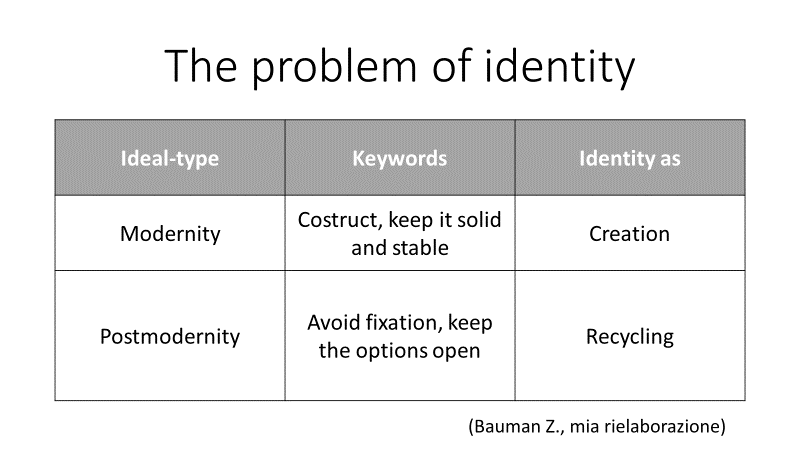
Let us briefly comment on the figure above. First, we are faced with a diachronic contrast between two discontinuous periods of history, at least of Western heritage . This contrast is not a given; it would be a mistake to assume these periodizations as "fixed" or "given once and for all" without questioning them. Therefore, it is best to warn the less attentive reader of this implicit problematic nature. Let us assume that " modernity " and " postmodernity " are ideal types, in Weber's sense. With this precaution, we can discuss the concept of identity by relating it to these two abstract historical individualities, condensed into "pure types."
What we find in the center and to the right of the image – that is, the keywords that trace the contours of identity in one context rather than another – represents an (almost) polar interpretative model of the identity problem that sees in the metaphor of liquidity (and, conversely, solidity) a possible epistemological solution . The solution proposed by Bauman, in my interpretation, can make a valid contribution to the analysis of the postmodern discomfort in the search for the "true self" (as if it were possible to know it; as if a "true self" existed – all obsessions of the modern individual...) by individuals in this context. However, one cannot help but notice that Bauman's proposal to the tangle of identity is insufficient if we think of it as an individualistic and individualizing solution. In some other passages of the passage, in fact, Bauman states that
"It is the individual's task to find a way out of uncertainty. "
( Ibidem , my translation from English)
And a few lines before, summarizing the concepts expressed previously, he commented as
« [I]dentity has the ontological status of a project and a postulate »
( Ibidem , my translation from English)
For Bauman , this individual, private, and project-based conception of identity seems to be in a state of constant instability in the postmodern context; but while modernity seemed to provide the tools for its solidification, postmodernity seems to offer those for its liquefaction. In short, postmodernity, according to Bauman , has laid the foundations and the related corollary for a whole series of phenomena of identity destructuring: it seems that no individual wants to adhere to an identity given once and for all; in this realm, the fluidity of representations and the non-givenness of every characterization seem to dominate—just like a liquid that changes shape depending on the container that holds it.
Bibliography :
AA.VV., Sociology , Einaudi school, Milan, 2015, pp. 270-271.


