


























The Charlie Gard case is shaking international public opinion. Is it legitimate for a state, a court, or public authorities to decide to suspend treatment , ending the life, however brief, of a human being against the parents' will? Whose decision is it in this case? We undoubtedly live in an era of transition, an era that, beneath the apparent social fluidity , conceals power relations and conflicts that constitute a challenge, if not for politicians, now preoccupied with finding legitimacy for their own inadequate actions, then for every individual with a conscience.
Mens sana in corpore sano

Previous contributions on biocapitalism and psychocapitalism have described the developments of this era and the market's invasion of the personal and intimate sphere, both physical and emotional. Between the two world wars, we witnessed a sharp increase in public spending —implemented by the same European dictatorships that devastated our continent in the first half of the last century—and in the postwar period, the establishment of social security and public healthcare funds, initially established in our country by fascism in the form of social insurance (mutual insurance), later transformed into universal healthcare.
Health and life are now enshrined as rights, but also as duties. The state and its branches guarantee healthcare and demand that citizens pay attention to health and hygiene , for their own protection and that of others. Mandatory vaccinations eradicate numerous infectious diseases, while psychiatry —at the intersection of healthcare and social control—is transformed from a creator of stigma and social marginalization to an agency of inclusion and rehabilitation through profound self-criticism and innovative legislation—a field in which Italy has excelled and set a precedent.
This is the time for the dissemination of psychological sciences and the diversification of psychotherapeutic paradigms. Well-being is increasingly a right but also a duty. The country needs an efficient workforce, and economic growth can guarantee good social security benefits for those no longer capable of ensuring maximum efficiency. But this could not last long, and at the end of the last century, something began to change.
The end of the golden age
This trend was slowed and eventually reversed, thus contracting employment, public spending , and economic growth (the three are connected). This process accelerated with the birth of the European common currency , built on monetarist and ordoliberal foundations, and was supported and legitimized by inflation-phobic, deficit-phobic ideological propaganda in favor of privatization. This legitimacy occurred by identifying regressive measures—including an unconstitutional reduction in tax progressivity—with concepts such as progress and modernity , which had positive connotations and were considered as inevitable, just like the recourse to the shock economy.
The right to health
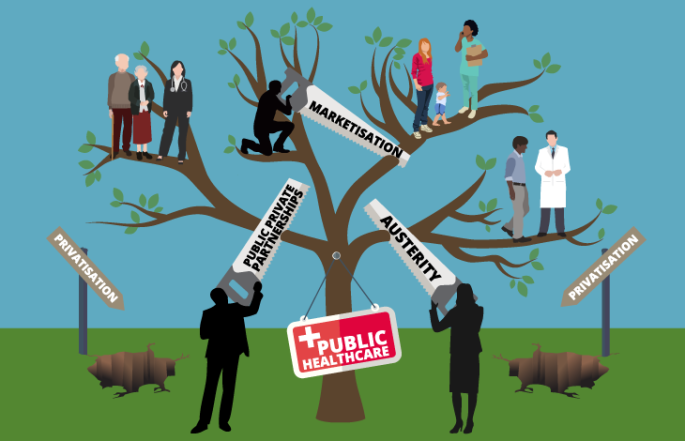
The European Union sets a minimum unemployment rate to avoid disrupting the value of the currency, and the one imposed on Italy is quite high—no longer pockets of spare labor, but chronically marginalized workers who no longer require care and treatment, no longer having to serve the productive system. It is therefore decided to cut healthcare spending, creating further unemployment and significant congestion in the National Health System, thus also decreasing life expectancy.
Now, the body, mind, and their well-being are no longer guaranteed and controlled by the state. They become a luxury for those who can afford them. Health insurance policies , once meaningless, are beginning to be taken into consideration even in the Old Continent. Many European countries are returning to a mutual insurance system—services are guaranteed only to those who pay contributions—with a consequent Americanization of the system. We might think that a reduction in rights also corresponds to a reduction in obligations, but this is not the case.
The Veil of Maya
Health systems and public interest do not disappear, they are simply privatized . Thus, the body and mind are no longer managed by the individual, but increasingly tend to be the object of economic transactions—insurance, gamete business, organ trafficking, surrogate wombs.

The state body does not return to being individual, but becomes private , as it is subject to possible transfers to third parties and economic transactions, even through professional intermediaries (private companies). Consequently, what was once considered a right now presents itself as " freedom " (but the two terms are often confused), a right accessible only through economic means. But duties are not alleviated. Doesn't the much-publicized right to euthanasia conceal a lack of interest in keeping the unproductive alive with expensive systems and therapies? The veil of Maya is suddenly torn in the face of the tragic experience of Mr. and Mrs. Gard, and we glimpse reality for what it is, behind the opaque veil that paints scenarios of progress, freedom, and human protection.
Reflecting on bioethics is increasingly important today for social scientists of any orientation and any branch of sociological knowledge.
Barbara Lattanzi


